
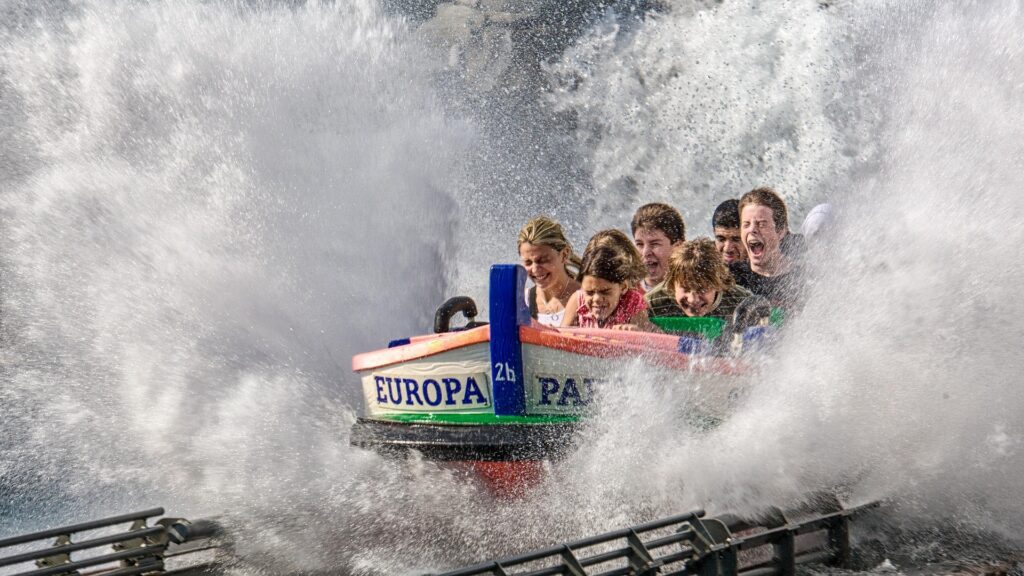
A child can be old enough for a water park and still be too short for many of its slides.
That distinction is easy to miss when booking. Parks tend to promote themselves as suitable for families or divide their attractions into children’s, moderate and high-adrenaline rides. None of those descriptions tells you whether an individual child will actually be allowed on.
For that you need the height restrictions.
Table of Contents
Why water slides have minimum heights
Restrictions are based on the design of each attraction.
The depth of the landing pool, speed of the slide and size of the raft can all affect the minimum height. Some rides also use restraints or seating positions designed for riders within a particular size range.
Swimming ability does not override these rules. Neither does age.
A confident ten-year-old below the line will usually be refused while a taller child of the same age may be allowed through. Lifeguards are responsible for applying the stated limits and will not normally have any discretion.
The limits are different on every ride
There is no single minimum height covering every attraction at a Spanish water park.
Small slides in children’s areas may have no meaningful restriction beyond parental supervision. Larger family rides often allow shorter children if they travel with an adult. Fast body slides and high drops usually have stricter limits.
The same park can therefore have several different rules:
- A minimum height to use a ride with an adult
- A higher minimum height to ride alone
- A fixed limit regardless of adult supervision
- A maximum height or age in areas intended for small children
This matters when comparing parks. A site advertising twenty attractions may only have a handful that every member of a particular family can use.
The number of suitable rides is more useful than the total number shown on the homepage.
Check before buying tickets
Most major parks publish restrictions online but the information is not always easy to find.
Start with the individual attraction pages. If the limits are not shown there check the park map, frequently asked questions and downloadable visitor information. Some maps use symbols rather than explaining the rules in writing.
If the information is missing or unclear contact the park directly.
Do not rely on reviews from previous visitors. Restrictions can change following alterations to a ride or a safety review. Different slides with similar names can also have completely different requirements.
Families choosing between parks may find our article on the best water parks in Spain by child age useful. Age is a reasonable starting point but it should always be checked against the current ride limits.
Measure children without shoes
Parks usually measure children barefoot because that is how they will use the attraction.
Measure from the floor to the top of the head while the child is standing straight and looking forwards. Do not add a little extra for sandals, thick hair or the possibility that nobody will check.
They will often check.
A child sitting just below a minimum height at home should be treated as too short when planning the day. Measurements can vary slightly and building the visit around one borderline ride is likely to end badly.
This is particularly important when the main attraction is heavily featured in the park’s advertising. Buying a ticket does not guarantee access to every slide.
Look for accompanied ride rules
Being below the height required to ride alone does not always mean a child is excluded.
Some family raft rides have a lower limit for children accompanied by an adult. Others allow smaller children to sit in a particular position within a multi-person raft.
The wording matters. “Accompanied by an adult” is different from simply having an adult waiting at the bottom.
Check whether the accompanying adult must ride and whether one adult can accompany more than one child. This can affect families with several young children or only one adult willing to use the slides.
Think about the whole group
Height restrictions cause the most difficulty when one child qualifies and another just misses the limit.
The family may have to separate while one adult queues with the taller child. The other adult and child then need something nearby to do. Repeating this across several attractions can turn a shared day out into two different visits.
Before booking count the rides available to the shortest child. Check whether suitable attractions are spread around the park or confined to one small children’s section.
A less famous park with a good range of usable slides may work better than a larger park dominated by attractions one child cannot enter.
What happens if a child is too short?
The lifeguard will refuse access.
This may happen at the entrance to the attraction or after the child has already climbed the tower. Staff cannot make an exception because tickets have been purchased or because the child has used a similar slide elsewhere.
It is worth checking the measurement marker before joining a long queue. Nobody wants to discover the problem after climbing several flights of the stairs found throughout Spanish water parks.
Height restrictions are not the most interesting part of planning a water park visit. They may be the part that determines whether the park is worth booking at all.
